
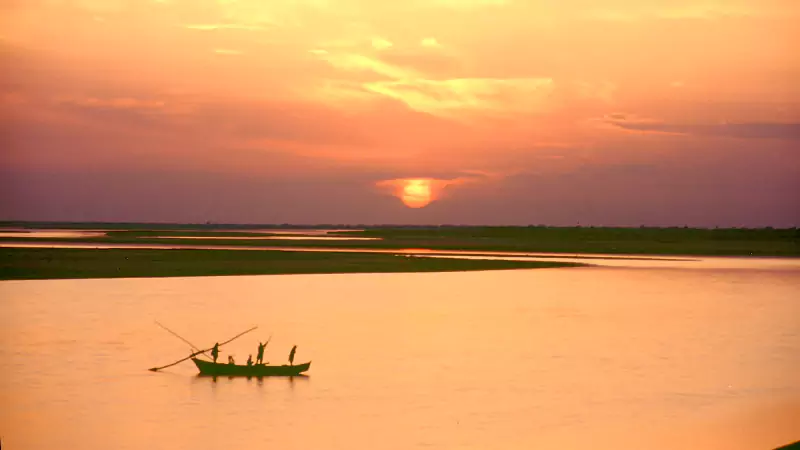
“Je aithon kadi Ravi langh jave,
Hayati Punjabi ban jave,
Main bediyan hazaar tod lan,
Main pani cho saah nichod lan.”
If the Ravi flows here, I will breathe Punjab. I will shatter chains, wring life out of her waters.
This song—Sajjad Ali’s—wrecks me. It’s trending on Instagram now, but it’s more than a song. It’s a cry. A cry of people away from home, people aching for childhood lanes, kitchens that smelled of ghee and onions, voices of friends, laughter of family, the warm womb of Punjab.
But listen deeper.
“Je Ravi vich pani koi nai,
Te apni kahani koi nai,
Je sang beliya koi na,
Te kise nu sunani koi nai.”
If Ravi dries up, I lose my story. If my friends aren’t there, who will even listen?
Punjab—Punj-aab—land of five rivers. Beas and Satluj here in India, Chenab and Jhelum in Pakistan, Ravi in both. Ravi—the only one who still dares to belong to both of us. She flows across scarred lands, a reminder of what we lost when lines were drawn in 1947.
Partition never really ended. Its ghosts still breathe in our songs and poems. They walk the fields, sit by the rivers, haunt the kites that once flew in shared skies. They wail in a bride’s throat as she leaves her home, they whisper in the silence between two friends remembering winters past. Lyrics become graves for dreams we buried. And yet, words loosen the chains that borders forged.
Ravi flows both sides. She doesn’t need a passport. She doesn’t care for barbed wire. She carries stories, losses, mothers’ tears, children’s giggles—across. For you in Lahore, for me in Amritsar.
And so when we sing of her, we sing of us.
It’s not the first time. In 2015, Gurdas Mann and Diljit Dosanjh gave us Ki Banu Duniya Da, lifting lines from Sarwar Gulshan, a Pakistani singer:
“Sanu sauda nahi pugda
Ravi to Chenab puchda
Ki haal e Satluj da…”
Chenab asks Ravi about Satluj, like siblings separated, still trying to check in on one another.
“Painde dur Peshawar’an de oye
O Wagah de border te
Raah puchhdi Lahore’an de haye…”
At Wagah, I ask for roads to Lahore. None exist. Only fences, soldiers, suspicion.
Tell me, isn’t that pain unbearable? Amritsar and Lahore—twin cities, once one body, same tongue, same food, same festivals. Now we’re told to hate each other. We’re told we are enemies, when in truth we are shadows split by a blade.
Listen to Piyush Mishra’s Husna. A lover mourning his beloved left behind in Lahore. He asks her—do the trees still shed in autumn the same way? Does the sun rise there like it does here? He wonders if they still sing Heer-Ranjha, if they still read Bulleh Shah, if Lohri smoke still rises.
“O Husna meri ye toh bata do
Lohri ka dhuan kya ab bhi nikalta hai
jaise nikalta tha
us daur mein vahan…”
He cannot accept borders. He wants to believe Lahore still holds the same heartbeat, even if it’s been torn away.
“Ye Heeron ke Ranjhon ke nagme
Kya ab bhi sune jaate hain vahan?
Aur rota hai raaton mein
Pakistan kya vaise hi
Jaise Hindustan?”
I don’t need to translate this. The wound is already bleeding. Nostalgia drips from every word.
More than seventy years gone. People carried what they could—steel trunks, utensils, a few clothes. But how do you carry air? How do you carry a courtyard’s laughter, a neighbor’s song, the way kites flew across rooftops without permission? They left those behind. Some wrote. Some sang. Others stayed silent, but their silence hums in songs like Ravi, Ki Banu, Husna.
And me? I sit and wonder. If there had been no borders, would these songs exist? Would this pain, this nostalgia, this haunting beauty have been born? If Chenab and Jhelum still flowed in Indian Punjab, would our throats still choke on longing? If Javed had Husna in his arms, would his song cut this deep? If there were highways between Amritsar and Lahore instead of no-man’s-land, would poetry still rise from the wound?
Maybe not. Maybe we needed the cut to learn how to bleed into verse. Maybe grief is what keeps our music holy.
But still, tell me—wouldn’t it be better if we never had to sing like this at all?

Leave a Comment